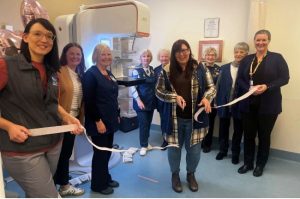
The Campbell River Hospital got its hands on a new mammography machine in November. The machine, which cost roughly $398,000, was completely funded by the Campbell River Hospital Auxiliary. “All the money we raised is from proceeds made in the hospital thrift shop and the hospital gift shop, as well as donations.” said Sharilyn Irving, the president of the auxiliary. “The hospital auxiliary is 100 per cent volunteer-run, so all the proceeds go to purchase equipment and pay for training for the hospital.” The mammography machine is a Siemens Healthineers Mammomat B. Brilliant. A mammogram is an X-ray of the breast and is used to find breast cancer. According to the Canadian Cancer Society, it is the most common cancer among women in the country (excluding non-melanoma skin cancers) and is the second leading cause of death from cancer in women. The society estimated that 31,900 women would be diagnosed with breast cancer in 2025, and that 5,400 women would pass away due to breast cancer. On average, 87 women in Canada will be diagnosed with the cancer every day, with an average of 15 dying per day. Men can also get breast cancer. On average, 290 men are diagnosed every year, with 55 dying. “It hits home a little bit more for women and for us,” said Irving. “We originally were approached for donating a little bit towards it, as they knew the machine was quite expensive. It was actually quite a bit of a rush decision because they had a very short time frame with an offer that was given to them, where they could turn in the old mammography machine and get a credit to reduce the price of this machine. When we took it to our auxiliary, everybody on the auxiliary was all in favour of funding this 100 per cent.” Last September, the auxiliary purchased a system called the Molli Seed. It was for people waiting for breast surgeries, allowing a technician to implant a small tracker into the breast up to a month before a surgery. “In the past, they would have to get wires implanted,” said Irving. “If someone implanting the wires called in sick, the surgery would get cancelled, and they would get backed up.” Irving said that when a doctor approached them about a mammography machine, the auxiliary felt it went hand-in-hand with the system they had just purchased. The auxiliary also purchased the last mammography machine for the hospital seven or eight years ago.
Brenda Jure